
Sensitive Teeth During Pregnancy: Is It Normal, and What Helps?
Updated: Oct 2
Yes, sensitive teeth during pregnancy are common, and for most women they settle down after the baby arrives. Tooth sensitivity is the short, sharp twinge you feel when something cold, hot, sweet or sour touches a tooth, and pregnancy makes it more likely for a few simple reasons.
Let me explain what is going on, what you can do about it at home tonight, and the few signs that mean you should come in rather than wait it out.
The short version
• Sensitive teeth are common in pregnancy. Swollen gums, morning sickness and more frequent snacking all make teeth more reactive.
• It is not a reliable sign that you are pregnant. A pregnancy test is.
• A soft brush, a toothpaste for sensitive teeth, and a baking soda rinse after vomiting help most women.
• Check-ups, cleanings, x-rays and freezing are safe at any stage of pregnancy. Pain that lingers, swelling, or one tooth that keeps hurting should be seen.
Written by Dr. Gloria Jung, DDS, BSc, at Dentudio Dentists in Richmond. Reviewed on 2 October 2026 against HealthLink BC, CDC, ACOG and European Federation of Periodontology guidance, listed at the end of this post.
Is it normal to have sensitive teeth during pregnancy?
Yes. It is one of the most common things pregnant patients mention in the chair, often a little apologetically, as if they have done something wrong. You haven't. Your body is changing quickly, and your mouth is part of your body.
The biggest change happens in the gums. According to the CDC, about 60 to 75 percent of pregnant women have gingivitis, the early and reversible stage of gum disease where the gums turn red, puffy and bleed easily. Pregnancy hormones make your gums react much more strongly to the same amount of plaque than they did before. Gums that are inflamed and tender make the teeth they hold feel tender too.
Why does pregnancy make your teeth sensitive?
There are usually three reasons, and most women have more than one of them.
Your gums are inflamed. Pregnancy gingivitis makes the gums swell and bleed, and where they pull back even a little, part of the root is exposed. Roots are not covered by enamel. They are covered by dentin (the layer under the enamel), which is full of tiny channels that lead towards the nerve. Cold water finds those channels very quickly.
Morning sickness brings acid. Stomach acid softens the outer surface of the enamel. If you are vomiting often, or have reflux later in pregnancy, the enamel slowly wears thinner and the teeth become more reactive.
You are eating more often. Cravings and small, frequent meals are completely normal. But every snack starts a new acid attack on the teeth, and sipping juice through the afternoon is one long attack.
There is a fourth, quieter reason. Many women find that brushing makes them gag in early pregnancy, so they brush less, or skip the back teeth. Less brushing means more plaque, and more plaque means angrier gums.
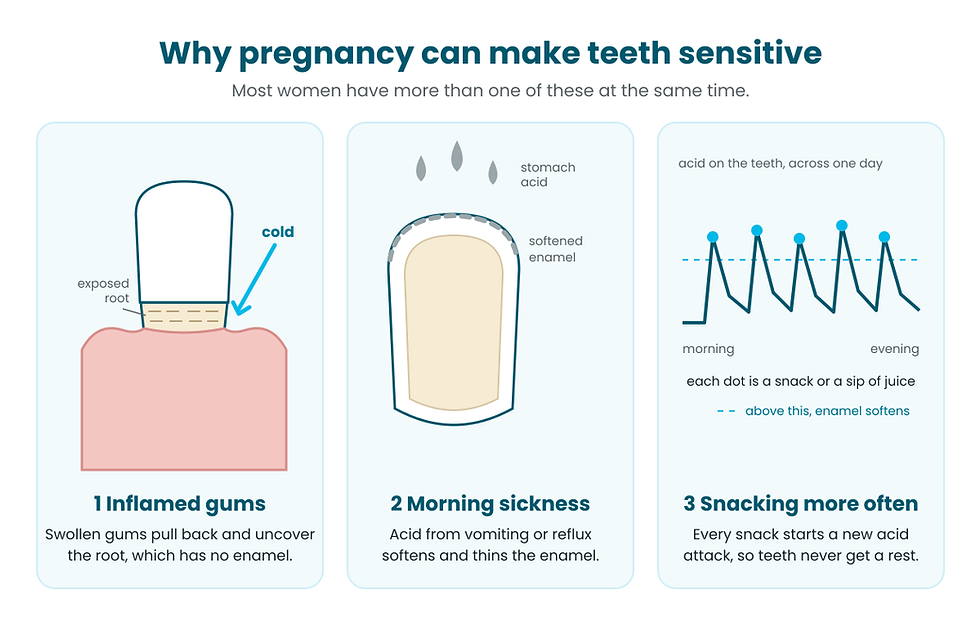
Three reasons, and most women have more than one. The same information is written out above.
Is sensitive teeth a sign of early pregnancy?
Not a reliable one. Gum changes can start early, so some women do notice tender gums or a twinge before they know they are pregnant. But tooth sensitivity has plenty of ordinary causes that have nothing to do with pregnancy: a whitening toothpaste, brushing too hard, a cracked filling, a new cavity, or gums that have receded over the years.
If you are wondering whether you are pregnant, take a test. If you are wondering why your teeth hurt, that part is our job.
When does it start, and when does it go away?
Gum inflammation tends to build as the pregnancy goes on, and most studies find it is worst in the third trimester, according to the European Federation of Periodontology's review of the research. The good news is that it reverses. Gum inflammation usually returns to early-pregnancy levels about three months after delivery.
So if your teeth are still sensitive four or five months after the baby is born, please don't put it down to "just the pregnancy". Something else may be going on, and it is worth a look.
What helps sensitive teeth during pregnancy?
Most of this you can start tonight.
Switch to a soft toothbrush and brush gently along the gumline. Hard bristles and scrubbing wear away exactly the surface you are trying to protect.
Use a toothpaste made for sensitive teeth, twice a day, and give it a few weeks. These toothpastes work slowly, by building up a barrier over those tiny channels in the dentin.
After vomiting, rinse, then wait. Rinse with one teaspoon of baking soda in a cup of water, which neutralizes the acid. Then wait 30 minutes before brushing, because brushing straight away scrubs acid into softened enamel. This is the advice from both HealthLink BC and ACOG.
If brushing makes you gag, use a small-headed brush, brush slowly, and try a toothpaste with a milder flavour. Brushing at a different time of day can help too.
Floss once a day, even if your gums bleed. Bleeding is a sign the gums are inflamed, not a sign to stop. It often calms down within a couple of weeks of gentle, daily flossing.
Drink water after snacks. Plain water rinses sugar and acid off the teeth, and it is the easiest habit on this list.
"But Dr. Jung, cold water is the only thing that settles my nausea!" Sure thing. Drink it through a straw, so it reaches the back of your mouth instead of washing over the front teeth.
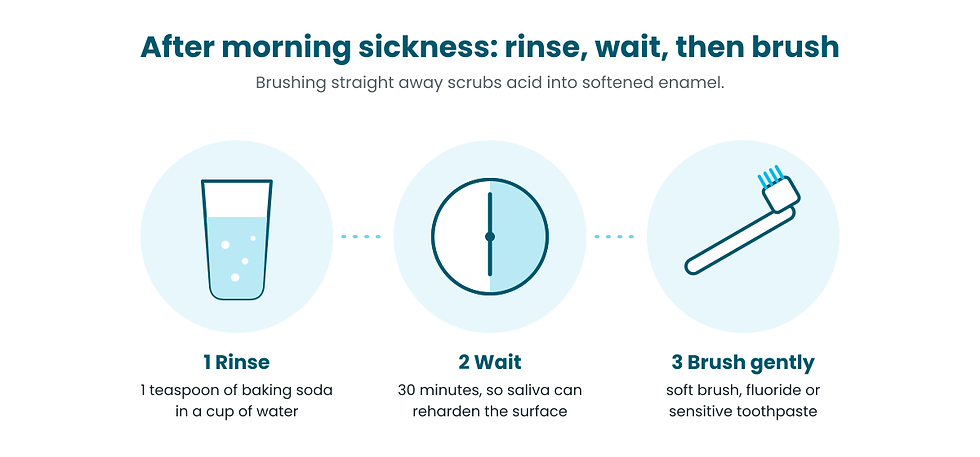
Save this one for the mornings that need it.
Is it safe to see the dentist while pregnant?
Yes. HealthLink BC states that regular dental cleanings and check-ups are safe at any time during pregnancy, and the CDC says the same of both regular and emergency dental care. Dental x-rays and local anaesthetic (freezing) can be used safely when they are needed.
What I recommend is simple. Tell us you are pregnant when you book, and again in the chair. A cleaning and check-up is worth doing at any stage, because treating gingivitis early is exactly what stops it becoming painful. If you need a filling or other routine work, the second trimester is usually the most comfortable time, since morning sickness has often eased and lying back is still easy. Anything urgent, like an infection or a painful tooth, should be treated when it happens, not left until after the birth.
Pregnant and your teeth are bothering you?
Open 9am to 5pm, seven days a week, so a weekend appointment is easy.
When should a pregnant woman see a dentist about tooth pain?
A quick twinge that fades in a second or two, from cold or sweet things, is classic sensitivity. It is worth mentioning at your next visit, but it can usually wait. These are the signs that should not wait:
What you notice | What it can mean | What to do |
A quick twinge with cold or sweet that fades in seconds | Ordinary sensitivity | Sensitive toothpaste and a soft brush. Mention it at your next check-up |
Gums that bleed when you brush | Pregnancy gingivitis | Keep brushing and flossing gently. Book a cleaning |
Pain that lingers, throbs, or wakes you at night | A cavity or an irritated nerve | Call us this week |
One tooth that hurts when you bite | A crack or a deep cavity | Call us this week |
Swelling in the gum or face, a bad taste, or a fever | Infection | Call us today. Infections should be treated during pregnancy |
A red lump on the gum that bleeds easily | Often a pregnancy tumour (a harmless overgrowth of gum tissue) | Have it checked, so we can confirm what it is |
That last one sounds alarming, so let me explain. A "pregnancy tumour" is not cancer. It is a soft, red overgrowth of gum tissue, usually between two teeth, that bleeds easily. The European Federation of Periodontology describes it as usually appearing in the second trimester, and it often shrinks on its own after the baby is born. We still like to see it, because only an examination can tell it apart from other lumps.
Not sure which row you are in?
Does the baby take calcium from your teeth?
No. This is one of the oldest myths about pregnancy. The minerals in your teeth are not pulled out to build the baby's skeleton; your baby's calcium comes from what you eat and drink. When teeth get worse during pregnancy, it is the gums, the acid and the snacking we talked about above, and all three of those are things we can work on together.
Looking after your teeth while pregnant, at Dentudio in Richmond
A few practical things, since people ask them at the front desk:
We are open seven days a week, 9am to 5pm. That makes it easier to fit a visit around work, prenatal appointments, and the days when mornings are hard.
Our hygienists are what our patients write about. We have 573 Google reviews with an average of 4.9, and more than 100 of those mentions are about our hygienists. A gentle, thorough cleaning is the single most useful thing for pregnancy gums.
We speak your language. I speak English, Korean and Mandarin, and our team also serves patients in Chinese and Korean.
Coverage questions are welcome. If you have no dental insurance, you may qualify for the Canadian Dental Care Plan. Our guide to what the CDCP covers walks through it, and our front desk can check your coverage before any treatment.
Frequently asked questions
Is it normal for teeth to be sensitive during pregnancy?
Yes. Pregnancy hormones make the gums react more strongly to plaque, and about 60 to 75 percent of pregnant women develop gingivitis, according to the CDC. Inflamed gums, acid from morning sickness and more frequent snacking all make teeth more sensitive. It usually settles within a few months of giving birth. Lingering pain or swelling should be checked by a dentist.
Can sensitive teeth be a sign of early pregnancy?
Not a reliable one. Some women do notice tender gums or a twinge early on, because gum changes can begin in the first trimester. But sensitivity has many everyday causes, including whitening toothpaste, brushing too hard, receding gums and cavities. A pregnancy test is the only reliable answer. A dentist can find out what is causing the sensitivity.
Can I use toothpaste for sensitive teeth while pregnant?
Yes, a regular toothpaste for sensitive teeth is fine for most pregnant women, used twice a day like any toothpaste. Give it a few weeks to work, because it builds up slowly. Use a soft brush and gentle strokes along the gumline. If sensitivity does not improve after a month, see your dentist, since a cavity or crack can feel the same.
Are dental x-rays safe during pregnancy?
Yes. Dental x-rays use a very small dose and can be taken safely during pregnancy when they are needed, according to ACOG and the CDC. A dentist should only take x-rays that answer a real question, such as why one tooth hurts. Always tell the clinic you are pregnant when you book and again before any x-ray, so the team can plan around it.
What should I do after vomiting from morning sickness?
Rinse your mouth with one teaspoon of baking soda dissolved in a cup of water to neutralize the stomach acid, then wait 30 minutes before brushing. Brushing straight away rubs acid into enamel that has just been softened. This is the advice given by both HealthLink BC and ACOG. Plain water is better than nothing if baking soda is not handy.
Will my teeth stop being sensitive after the baby is born?
Usually, yes. Gum inflammation from pregnancy generally returns to early-pregnancy levels about three months after delivery. If your teeth are still sensitive four or five months after the birth, something else may be causing it, such as a cavity, a cracked filling or gum recession, and it is worth having it checked by your dentist.
Book a check-up in Richmond
Two people are eating now, but only one of you has teeth, so look after them! If something is bothering you, tell us you are pregnant when you book, and we will take it from there.
Or call 604-370-1450. Dentudio Dentists, 145-5555 Gilbert Road, Richmond, BC. Open 9am to 5pm, seven days a week.
Sources: CDC, Talking to Pregnant Women about Oral Health and Pregnancy and Oral Health Facts (15 May 2024); HealthLink BC File 38b, Dental Health for Pregnant Women; ACOG Committee Opinion 569, Oral Health Care During Pregnancy and Through the Lifespan (2013); E. Figuero and M. Sanz, Women's Oral Health During Pregnancy, European Federation of Periodontology. Review count from Google, 2 October 2026.
Dr. Gloria Jung, DDS, BSc


Comments