

Does MSP Cover Dental in BC? What Is Covered, and What Is Not
Updated: Oct 2
No, for most people MSP does not cover dental care. MSP, the Medical Services Plan, is British Columbia's public health insurance: it pays for medically required care from doctors and a short list of other services, and checkups, cleanings, fillings, crowns and routine extractions at a dental office are not on that list.
So who does pay? Let me explain: there are a few narrow exceptions inside MSP, a handful of public programs that cover some people, and a lot of fine print in workplace plans. By the end you will know which of them applies to you, and what to ask before any treatment.
The short version
• MSP does not pay for routine dental care. It covers dental surgery only when it is medically required to be done in hospital, and never fillings, crowns or root canals.
• Healthy wisdom teeth are not covered by MSP, even when impacted.
• BC Healthy Kids, BC assistance, the federal CDCP and First Nations Health Benefits cover some people.
• Workplace plans pay a share, with frequency limits and a yearly maximum. Ask for a predetermination before major work.
Written by Dr. Gloria Jung, DDS, BSc, at Dentudio Dentists in Richmond. Reviewed on 2 October 2026 against Government of British Columbia, Government of Canada, First Nations Health Authority and BC Dental Association pages, listed at the end of this post.
Does MSP cover dental in BC?
No, not routine dental care. The BC government's list of MSP benefits mentions teeth in only three narrow places:
Dental and oral surgery, when it is medically required to be performed in hospital. Restorative work is excluded even then, and the government names fillings, caps, crowns and root canals as examples.
Orthodontic services related to severe congenital facial abnormalities, meaning serious differences in the face and jaw that a child is born with.
Diagnostic x-rays at an approved diagnostic facility, when a dentist or oral surgeon orders them. The x-rays taken in the chair at a dental office are part of your dental care, so they are not covered this way.
Everything else at a dental office, from the checkup to the crown, sits outside MSP. That surprises a lot of people, because MSP covers so much else. Most dental care never needs a hospital, and whether yours does is a medical decision your dentist or surgeon makes, not something you can choose to get it covered.
Does MSP cover dental extractions or wisdom teeth removal?
Usually not. A routine extraction at a dental office is dental care, so MSP does not pay for it.
For wisdom teeth, the government's wording is unusually specific. Removing healthy wisdom teeth is not a benefit, even if they are impacted (stuck under the gum or bone). MSP pays for removing an impacted wisdom tooth only when hospitalization is medically required, because the extraction is extremely complex and there is associated pathology, meaning disease around the tooth such as a cyst.
"But Dr. Jung, my wisdom tooth is impacted and it hurts. Surely that counts?" Not on its own. An impacted, sore wisdom tooth is common, and it is usually treated at a dental office with freezing, sometimes with sedation. That visit is paid by you or your dental plan. If your case is complex enough to need a hospital, your dentist or oral surgeon will tell you, and arrange it.
And not every impacted wisdom tooth needs to come out at all. If it is healthy, causing no problems and can be kept clean, keeping an eye on it with x-rays is a reasonable plan. Our wisdom teeth page explains how we decide.
Wondering what an extraction would cost you?
Bring your plan details. Our front desk can check your coverage before any treatment.
Who pays for dental care in BC, if not MSP?
Several payers share the job, and most people only ever use one or two of them. Here is the whole map.

The same information is in the table below.
Who pays, and for whom | What it covers |
MSP, for everyone enrolled | Dental surgery that must be done in hospital, and braces for severe facial conditions present at birth. Not checkups, fillings, crowns or root canals |
BC Healthy Kids, for children under 19 in lower-income families not on assistance | Basic dental care up to a two-year limit, and emergency care for pain once that is used |
BC income assistance, for people on income, disability or hardship assistance | Emergency care for pain for everyone. Basic care up to a two-year limit for those eligible. Dentures, crowns and braces in some cases |
The CDCP, for residents with no dental insurance, under the federal income limit | Many common services at set fees. Some families pay a co-payment |
First Nations Health Benefits, for First Nations people with status who live in BC | Exams, x-rays, cleanings, fillings, root canals, crowns, bridges, dentures and dental surgery. Braces with age and medical criteria |
NIHB, for eligible Inuit living in BC | Federal dental benefits from Indigenous Services Canada |
A workplace or private plan, for you and your family | A share of each covered service, within frequency limits and a yearly maximum |
You | Co-payments, anything past a plan's limits or fees, and cosmetic choices |
BC Healthy Kids, for children
The Healthy Kids Program helps children in low-income families with basic dental care, eyeglasses and hearing care. A child qualifies when the family is eligible for MSP supplementary benefits, which are based on income, and is not receiving income, disability or hardship assistance. Basic dental care means services such as exams, cleanings, fillings and extractions, up to a set amount every two calendar years. Braces are not part of it.
Coverage lasts until the end of the month of the child's 19th birthday. Before treatment, give your dentist your child's Personal Health Number so the office can confirm coverage with Pacific Blue Cross, which runs the program for the province.
BC Employment and Assistance, for people on assistance
Everyone receiving income, disability or hardship assistance can get emergency dental care to relieve pain. Many recipients, and all children in families on assistance, also have basic dental coverage up to a limit every two calendar years. Dentures, crowns and bridges, and braces for severe facial and jaw deformities are covered only in specific situations. The dentist bills the program directly, but the program pays by its own fee schedule, so ask whether there will be anything left for you to pay.
The Canadian Dental Care Plan, if you have no insurance
The CDCP is the federal plan for residents who have no access to dental insurance, have filed their taxes, and have a family income under the federal limit. If you have access to any private or workplace dental plan, you are not eligible, even if you have never used it. It can be combined with Healthy Kids or BC assistance, and in that case the CDCP pays first. Our guide to what the CDCP covers walks through the details, so I won't repeat them here.
First Nations Health Benefits and NIHB
First Nations people with status who live in BC have a dental plan through the First Nations Health Authority's Health Benefits program, run with Pacific Blue Cross. Its coverage is in the table above. Ask your dental office whether it is registered with Pacific Blue Cross, so it can bill the plan directly. Eligible Inuit living in BC are covered by the federal Non-Insured Health Benefits program instead.
Does PharmaCare cover dental?
No. PharmaCare is BC's drug plan. It helps pay for prescription drugs, some medical devices and supplies, and pharmacy services. A prescription your dentist writes is filled at the pharmacy like any other, but the dental treatment itself is not part of PharmaCare.
How do workplace dental plans work in BC?
Most people in BC who have dental coverage get it through work, school or a union, or buy a plan themselves. Every plan is different, but they are built the same way: they sort dental work into groups, pay a share of each group, and limit how often and how much they pay.
The usual groups look like this:
Preventive: exams, x-rays, cleanings, fluoride and sealants.
Basic: fillings, root canals, gum treatment and oral surgery such as extractions.
Major: crowns, bridges, dentures and implants.
Orthodontic: braces and aligners.
One plan that publishes its rules in full is the Public Service Dental Care Plan for federal government employees, so it makes a useful example. After its deductible, it pays 90 percent for preventive and basic services, 65 percent for major services and 50 percent for orthodontics. Your plan's numbers will be different, but notice the shape: the share falls as the work gets bigger.
Most plans also limit how often they pay for routine care. These are the published limits in that same federal plan:
Service | How often that plan pays for it |
Recall exam | Once every 9 months, or every 6 months for children |
Complete exam | Once every 3 years |
Bitewing x-rays | Once every 9 months, or every 6 months for children |
Panoramic x-ray | Once every 3 years |
Cleaning and polishing | Once every 9 months, or every 6 months for children |
Fluoride | Once every 9 months, or every 6 months for children |
Scaling and root planing | 6 time units a year, each unit 15 minutes, plus up to 6 more if approved for gum disease |
This is why dates matter. If your plan pays for a cleaning once every nine months and your last one was eight months ago, the plan can say no today and yes next month. Scaling (removing tartar) is counted in time, so a longer cleaning for gum disease can use up a year's units in one or two visits.
Then there is the fee guide. The BC Dental Association publishes a suggested fee guide every year with more than 1,400 procedure codes. Dentists are not required to follow it, and many plans base what they pay on its fees and codes, sometimes on an older year's guide. So when a plan pays a percentage, it is a percentage of the fee the plan allows for that code, which can be less than the fee on your bill.
One honest note: you do not need to book treatment just because your benefits renew in January. If your dentist has not found anything that needs doing, there is nothing to use up. A healthy mouth is the best thing your plan can buy.
What happens if you have two dental plans?
They work together, which is called coordination of benefits. Your own plan pays first, and a plan that covers you as a spouse pays second, towards what is left. For children covered by both parents, the plan of the parent whose birthday comes first in the calendar year pays first. Only the month and day count, not the year. Together, two plans can pay up to the full eligible cost, but never more than it.
Tell us about every plan, including your spouse's. Leaving a second plan off the form is easy money to lose.
Are braces covered by dental insurance?
Sometimes, and usually only in part. In most workplace plans orthodontics is its own group, paid at a lower share and with its own maximum per person. In the federal plan above, for example, braces are paid at 50 percent up to a once-only orthodontic maximum, not a yearly one. Plans differ more here than anywhere else, so this is the one to check before you start.
Public programs pay for braces only in serious cases. MSP covers orthodontics for severe congenital facial abnormalities, BC assistance can cover children and adults with the Persons with Disabilities designation who have severe facial and jaw deformities, and First Nations Health Benefits cover orthodontics when age and medical criteria are met. Straightening teeth for appearance alone is paid by you or your own plan. If you are thinking about Invisalign, ask us for a predetermination first, so your plan's answer is in writing before you commit.
Is cosmetic dentistry covered by insurance?
Usually not. Plans pay to treat disease and repair damage, not to change how healthy teeth look. The federal plan above, for example, excludes services provided mainly for cosmetic purposes, and it will not pay extra for precious metals when a lower-cost material would do the job.
So whitening, and veneers on healthy teeth, are usually yours to pay. The line is not always obvious, though. A crown on a broken tooth is a repair, even if it also looks better, so a plan may pay its share of that. Ask before you assume either way.
And the honest part: if your teeth are healthy and you just want them whiter, that is a choice, not a need. That is perfectly fine, as long as nobody pretends otherwise.
How do you find out what you are covered for?
Ask your plan first, then ask us. Your dental office cannot see the details of your plan on its own, so a few minutes of homework before treatment saves surprises after it. Here is the checklist, in order:
Find your plan details. Your plan or policy number, your member or certificate number, and who the plan holder is. For Healthy Kids or BC assistance, the Personal Health Number on your BC Services Card.
Check what is left this year. How much of your yearly maximum you have used, and the dates of your last exam, x-rays and cleaning, so a frequency limit does not catch you out.
Ask for the treatment plan, with codes. Your dentist can give you the procedure codes and fees for what is recommended. Those codes are what your plan looks up.
Get a predetermination for major work. The office sends the treatment plan to your insurer, and the insurer replies with what it expects to pay. The BC Dental Association points out that this is an estimate, not a guarantee, and that it is usually valid for six months to a year.
Mention every plan you have. A spouse's plan, a second job, Healthy Kids, the CDCP or First Nations Health Benefits. The order they pay in matters.
The BC Dental Association adds one more piece of advice that I agree with completely: make treatment decisions based on your dental health needs, not on what your plan covers.
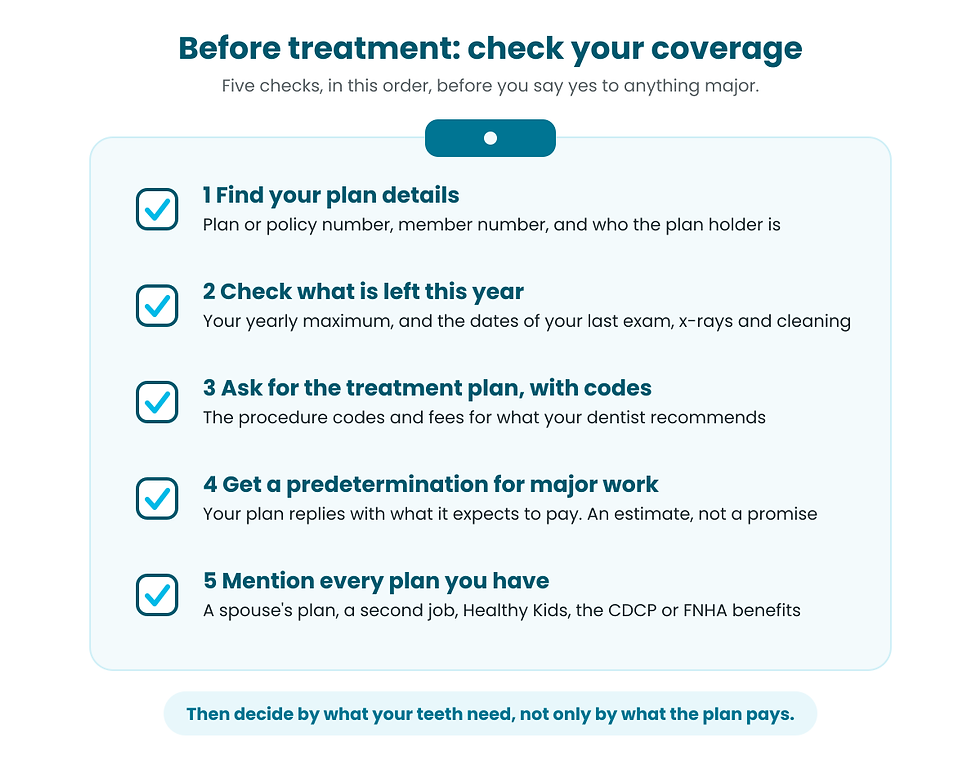
Five checks before you say yes to anything major. The same steps are written out above.
Want us to check your coverage first?
Open 9am to 5pm, seven days a week.
Checking your coverage at Dentudio in Richmond
A few practical things, since people ask them at the front desk:
Our front desk can check your coverage before any treatment. Bring your plan details, and we will go through what your plan is likely to pay before you decide anything.
We accept the CDCP. If you have no dental insurance, our CDCP guide explains who qualifies and what it covers.
We are open seven days a week, 9am to 5pm. Easier to fit a visit around work, school and family.
We speak your language. I speak English, Korean and Mandarin, and our team also serves patients in Chinese and Korean. Insurance wording is hard enough in your first language.
Frequently asked questions
Does MSP cover dental in BC?
No, MSP does not cover routine dental care such as checkups, cleanings, fillings, crowns or root canals. It covers dental and oral surgery only when it is medically required to be performed in hospital, orthodontics for severe congenital facial abnormalities, and some diagnostic x-rays ordered by a dentist. Most British Columbians pay for dental care themselves, through a workplace plan, or through a program such as Healthy Kids or the CDCP.
Does MSP cover wisdom teeth removal in BC?
Usually not. The BC government states that removing healthy wisdom teeth is not an MSP benefit, even if they are impacted. MSP covers surgical removal of an impacted wisdom tooth only when a hospital stay is medically required, because the extraction is extremely complex and there is disease around the tooth. Wisdom teeth removed at a dental office are paid by you or your dental plan.
Is there dental coverage for seniors in BC?
MSP does not cover routine dental care at any age. Many seniors without dental insurance can apply for the federal Canadian Dental Care Plan, whose rules are about insurance, income, tax filing and residency rather than age. Seniors receiving income or disability assistance may also have BC dental supplements. A retiree who still has a pension dental plan should use that plan.
Are braces covered by dental insurance?
Sometimes, and usually in part. Many workplace plans treat orthodontics as a separate group with a lower share and a once-only maximum per person. Public programs cover braces only in serious cases, such as severe congenital facial abnormalities under MSP. Plans vary widely, so ask your dentist to send a predetermination to your plan before starting braces or aligners.
Is cosmetic dentistry covered by insurance?
Usually not. Dental plans pay to treat disease and repair damage, not to change how healthy teeth look, so whitening and veneers on healthy teeth are normally paid by the patient. The line is not always obvious: a crown that repairs a broken tooth is treatment, even if it also improves your smile. A predetermination from your plan is the reliable way to find out.
What is a dental predetermination?
A predetermination is a request your dental office sends to your insurer before treatment, listing the procedure codes and fees. The insurer replies with what it expects to pay and what you will owe. The BC Dental Association notes it is an estimate, not a guarantee, and is usually valid for six months to a year, so reconfirm if your plan changes first.
Can I use the CDCP if I have a workplace dental plan?
No. You cannot get the Canadian Dental Care Plan if you have access to any private dental coverage, including through your job, a family member's plan, a pension or a health spending account. This applies even if you have never used the plan. The CDCP can, however, be combined with BC programs such as Healthy Kids or BC assistance.
Book a visit in Richmond
MSP looks after the hospital, your plan looks after a share, and your toothbrush looks after everything else. It is the cheapest coverage you will ever have! If you are unsure about any of it, our front desk is always on hand to explain your coverage to you.
Or call 604-370-1450. Dentudio Dentists, 145-5555 Gilbert Road, Richmond, BC. Open 9am to 5pm, seven days a week. Rated 4.9 from 573 Google reviews at the time of writing.
Sources, all read on 2 October 2026: Government of BC, Medical Benefits (MSP) and Supplementary Benefits; BCEA Policy and Procedure Manual, Healthy Kids and Dental and Orthodontic Services; Dental coverage while on income or disability assistance; BC PharmaCare. Government of Canada, CDCP: Do you qualify, and Coordination of benefits between the CDCP and British Columbia's dental programs (July 2026). First Nations Health Authority, Dental benefit. Indigenous Services Canada, NIHB Dental Benefits Guide and NIHB Annual Report 2023 to 2024. Treasury Board of Canada Secretariat, Public Service Dental Care Plan summary and Rules. BC Dental Association, Dental Costs in BC. Review count from Google, 2 October 2026.
Dr. Gloria Jung, DDS, BSc


Comments